Drumroll Please. Fanfare commence. Please welcome to the blog brilliant old, dead, British author George Eliot and brilliant not old, not dead British author David Mitchell! Hurrah, hurrah! Children dance on the street, sailors dip your girls and kiss, songs be sung, joy be had! These two authors are just amazing, just so incredible and as aforementioned, will be pimping them today for you on this blog for your personal amusement/betterment. Let's do this.
George Eliot (pen name of Mary Ann Evans) lived from 1819 to 1880, and was one of the leading authors of the Victorian Era. This was the best picture I could find of her---  I know, right? Girl was not cute. But please, please, please ignore the fact that Eliot does not fit in neatly with Western Society's standard of beauty (or like, any standard of physical beauty I can think of) because Eliot is hot on the inside. So hot. I read "Silas Marner" maybe my junior or senior year of high school, and yeah, it was okay, grouchy, rasty, old Silas learns to love the little cherub girl . A lot of people give up on Eliot after "Silas" which is a travesty, because after 'Silas' comes "Middlemarch."
Oh my God you guys, "Middlemarch" oh my God. I want to sleep with "Middlemarch, "forget" to take my birth control, get pregnant with its baby and force this book into a shotgun wedding with me. God, God, God. So, so good. I read this masterpiece summer of 2007. My handsome, brilliant father kept harping on me about reading it, he told me he read it like half a dozen times when he was my age. So I did. And Heaven be praised for it. "Middlemarch" is the story of a small British town in the 1860's (called MIDDLEMARCH!), and the complex social web that is its' denizens. This novel primarily follows crazy intense/ super-Jesus Dorothea Brooke who thinks she wants to marry this boring old man and then marries him finds out he's a boring old man and then all this drama happens. There's also Tertius Lydgate, he's this super-idealistic young doctor who marries this super -pretty girl who spends a lot of money all the time and he's like "Hmm. I'm just starting my medical practice and my wife is spending all my money, this isn't going to turn out too badly." But it does, you guys. It totally, totally does. There's a million other characters and they all are flawed and do stupid things with their lives and Eliot has mercy on NONE of them. Eliot is like the mean Old Testament God with her characters, plagues and floods aplenty. And it's awesome. Eliot is not Austen [note. Let the record show I do love Austen]. Eliot does not give her character's easy outs ("Oh. I all of a sudden came into a lot of money Miss. Darbingshireworth!" "Oh that's wonderful, Mr. Chetthamgatedale, because I all of a sudden realized the man I really love is you!") I mean, this is all fine and good but Austen, for as romantic and great as she is, is a pastel shade of tongue and cheek. Eliot is hard-core snarky. She's so hilarious. And so sad. And so good.
Okay, also, and this is hard for me to admit, sometimes books written before World War I are a little hard for me to read. Like I really love and appreciate Hawthorne and Melville, but the boys get dense, they just do. And that was really hard for me to admit because I'm a snotty, pretentious literati intellectual. But, but, "Middlemarch" is not dense-- you just dive right in and get sucked into all the snarkiness and pathos (Eliot can write snark and pathos at the same time! God I love this girl!) I mean it's really delicious, compulsive reading. But also thought-provoking, emotionally compelling, always topical and timeless, amazing amazingness. That's what makes it a classic. That's why you should read it. Middlemarch-hooray! A plus plus!
My next British author that I'm pimping to the masses is David Mitchell. David is way cuter than George, look. 
He also is just as good a writer. He also lives in an era of antibiotics, central heating, and internet. George Eliot's all "Wait, this is not fair." But George Eliot, then again, life, by definition, is not fair. You got to write an amazing book, have Henry James be in love with you even though you were ugly, and have lots of crazy Pre-Industrial Revolution trysts and adventures. So just be happy.
He also is just as good a writer. He also lives in an era of antibiotics, central heating, and internet. George Eliot's all "Wait, this is not fair." But George Eliot, then again, life, by definition, is not fair. You got to write an amazing book, have Henry James be in love with you even though you were ugly, and have lots of crazy Pre-Industrial Revolution trysts and adventures. So just be happy.
So here's the lowdown on the crazy-talented Mr. Mitchell. Born in 1969 (which makes him 38, which means that if he wasn't married with children and living in Japan and I wasn't a grad student with a boyfriend, it would only be mildly creepy if we hooked up!), Mitchell is the author of "Ghostwritten," "number9dream", "Cloud Atlas", and "Black Swan Green," the first two of which I have yet to read, the last two of which I devoured/worship.
So let's start with "Cloud Atlas." 
This book was published in 2004, and short-listed for the Man Booker Prize (why it didn't win is beyond me, committee people are stupid). So this is the story-- I used to work at a bookstore in LA and people were buying this sucker like it was going out of style, so I was like "Okay, I should read this." And I started it. And I was like--what the hell is this book? It started out with some odd 19th century ship log. The next chapter is, if I remember correctly, the letters of an early 20th century European musician who helps an aging pianist with his final compositions. Then it flashes forward to 1970's California, and follows a young, female journalist investigating murder and corruption at a nuclear power plant?Where is this book going? I don't know! And then it slowly hits me. It's the same person in all these stories-- the same soul moving across time, all across the world, through various historical periods, from the beginning of the Industrial Revolution through our time and beyond into post-Apocalyptic Hawaii! I know. I know. By the way, that was a bunch of spoilers, but whatever, I really don't think it will decrease your enjoyment of the book. So the book gets to Post-apocalyptic Hawaii and what does it do? What does it do? It goes back to the story before and finishes it up, and the story before, all the way back to finishing the 19th century ship blog! It's like one of those Matrishka Dolls that opens up and there's a smaller doll, and a smaller doll. Mitchell completely took dramatic structure and f***ed with it til it was to his liking and the results are fascinating and heartbreaking and mind-boggling and stupendous.
This book was published in 2004, and short-listed for the Man Booker Prize (why it didn't win is beyond me, committee people are stupid). So this is the story-- I used to work at a bookstore in LA and people were buying this sucker like it was going out of style, so I was like "Okay, I should read this." And I started it. And I was like--what the hell is this book? It started out with some odd 19th century ship log. The next chapter is, if I remember correctly, the letters of an early 20th century European musician who helps an aging pianist with his final compositions. Then it flashes forward to 1970's California, and follows a young, female journalist investigating murder and corruption at a nuclear power plant?Where is this book going? I don't know! And then it slowly hits me. It's the same person in all these stories-- the same soul moving across time, all across the world, through various historical periods, from the beginning of the Industrial Revolution through our time and beyond into post-Apocalyptic Hawaii! I know. I know. By the way, that was a bunch of spoilers, but whatever, I really don't think it will decrease your enjoyment of the book. So the book gets to Post-apocalyptic Hawaii and what does it do? What does it do? It goes back to the story before and finishes it up, and the story before, all the way back to finishing the 19th century ship blog! It's like one of those Matrishka Dolls that opens up and there's a smaller doll, and a smaller doll. Mitchell completely took dramatic structure and f***ed with it til it was to his liking and the results are fascinating and heartbreaking and mind-boggling and stupendous.
Now let's move on to "Black Swan Green. 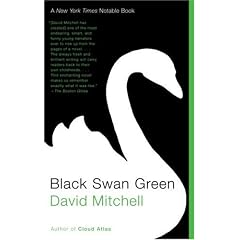
This book was published in 2006 and I finally read this at the end of last year (2007). I loved "Cloud Atlas" so much I don't know why I didn't pick this up immediately after. I think partly it's because I have this thing where I'm more into bredth than depth (thank you American public education), and partly because Mitchell's next book isn't coming out til 2009, so I'm afraid if I read all his stuff right now I'll go crazy waiting for his next book (which is about Dutch traders in Japan during the Napoleonic Era- I can't wait, I can't wait!)
This book was published in 2006 and I finally read this at the end of last year (2007). I loved "Cloud Atlas" so much I don't know why I didn't pick this up immediately after. I think partly it's because I have this thing where I'm more into bredth than depth (thank you American public education), and partly because Mitchell's next book isn't coming out til 2009, so I'm afraid if I read all his stuff right now I'll go crazy waiting for his next book (which is about Dutch traders in Japan during the Napoleonic Era- I can't wait, I can't wait!)
But back to "Black Swan Green." Okay, so Mitchell has been doing all this sci-fi-y, f***ing with time and space and he's like "No, my next novel is going to be this semi-autobiographical work about me growing up in early-'80's Thatchery, Faulkland Islands War-y, rural England. I sure hope people like it." David, I liked it. David, I loved it. I love when crazy writers do this-- like Japanese author Haruki Murakami was like "Oh this magical realism is fun, but let me try to write a book where people don't walk through walls and clouds don't rain cats," and it was 'Norwegian Wood' and it was gorgeous. And then playwright David Lindsay Abaire was like "Oh, people know me for being crazy, quirky Abaire, but what if I wrote a simple, honest story about a modern family dealing with the grief of losing a child?" And it was "Rabbit Hole", and it won the Pulitzer Prize and that win was so, so well deserved. I love it when crazy writers write normal, it so often turns out so well.
So anyways, Mitchell ( I should just stick with calling him "David" or "Mitchell", but whatever) has created the most honest, specific, special, hilarious, gloomy, hopeful portrait of a young boy on the cusp of manhood. Jason Taylor, the novel's hero is a boy of middling social status who secretly publishes poety under pen name Eliot Bolivar in the local magazine, and prays no one finds out and thinks he's gay, because half the things he secretly likes (poetry, going for walks by himself) are considered gay, which is like being diagnosed with metatastic cancer if you're a middle-class boy in early '80's Britain.. or a boy anywhere in Patriarchal Western Society. Oh Modern Life, you never cease to find new ways to suck. Continuing on, the book follows Jason in a year in his life, January to December, and tracks the slow process of his maturation, the political climate of the world around, and the painful disintegration of his family.
Jason Taylor, it should be noted, is not a fictional character. Jason Taylor is a real person who dictated his trials and tribulations to David Mitchell, who proceeded to publish it as a book of fiction. I swear to God this is what happens. Holding this book in your hands isn't like holding a bound stack of paper, but rather like holding a living, breathing, blood-pumping and circulating creature with eyes, central nervous system, and a heart. Huge, huge-ass heart. I liked this bildungsroman [note. when I use this word, people that weren't English majors in undergrad don't know what I'm talking about. Growing up story, you guys. Bildungroman=Growing up.], anyways, I like this bildungsroman a little better than "Catcher in the Rye" and almost as much as "Harry Potter, " I swear. Read this because it's a smart look at middle-class Thatcher England, read this because you're having a hard time in life and need a cathartic book to laugh and cry, read it because it's fricking fantastic. Whatever your reason is, read it.
That's all. Go read.
Affectionately,
Kit Steinkellner

